
UNPLUG THE ICE MACHINE
Following the money behind ICE's private-sector propaganda machine
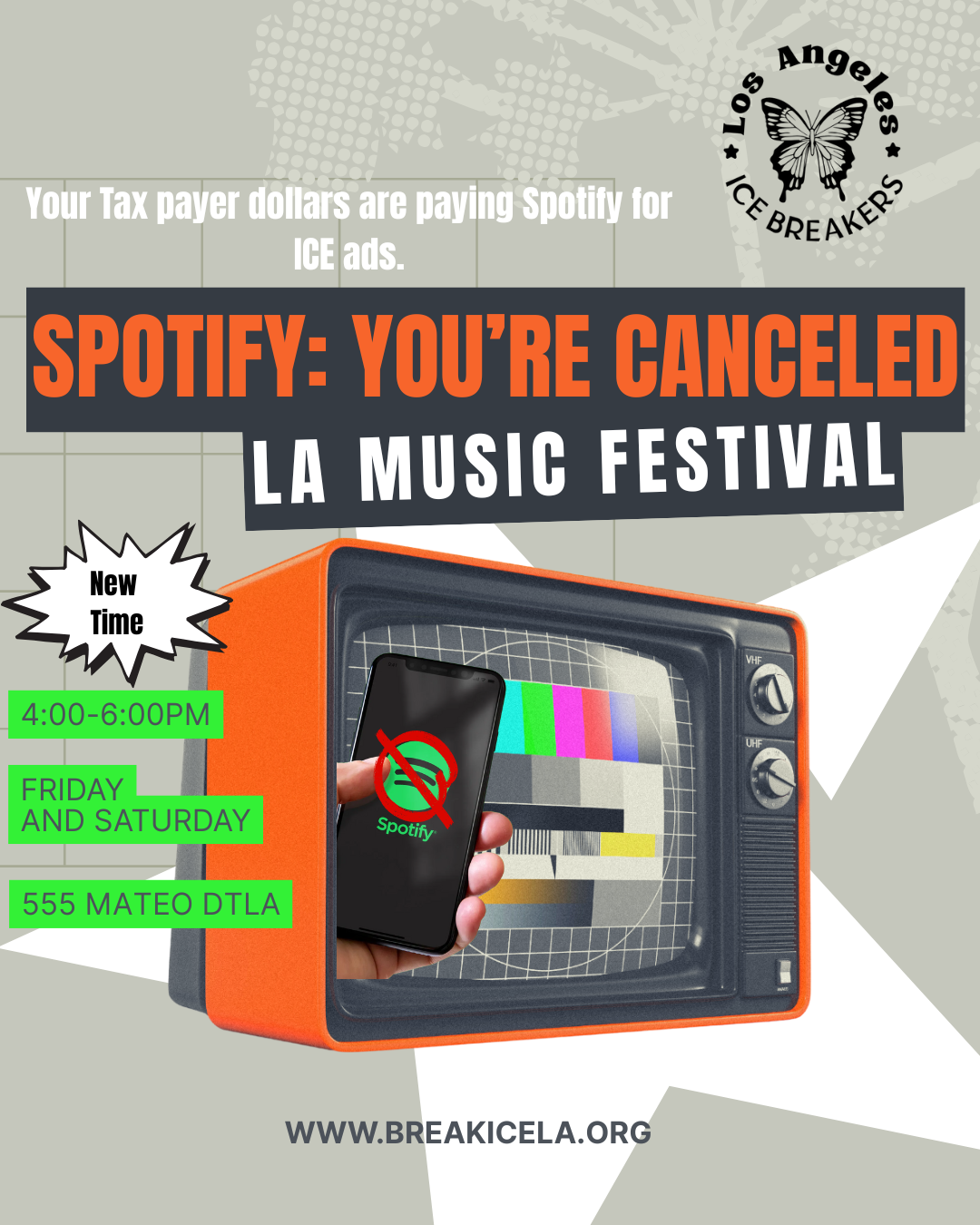
We started with Spotify. We're going after the entire infrastructure.
In 2025, ICE recruitment advertisements began appearing across the media people use every day: music streaming services, social media, video platforms, websites, and other digital spaces.
These weren't just isolated advertisements. They were part of a much larger federal communications and recruitment effort involving government agencies, private contractors, advertising companies, production firms, and media platforms.
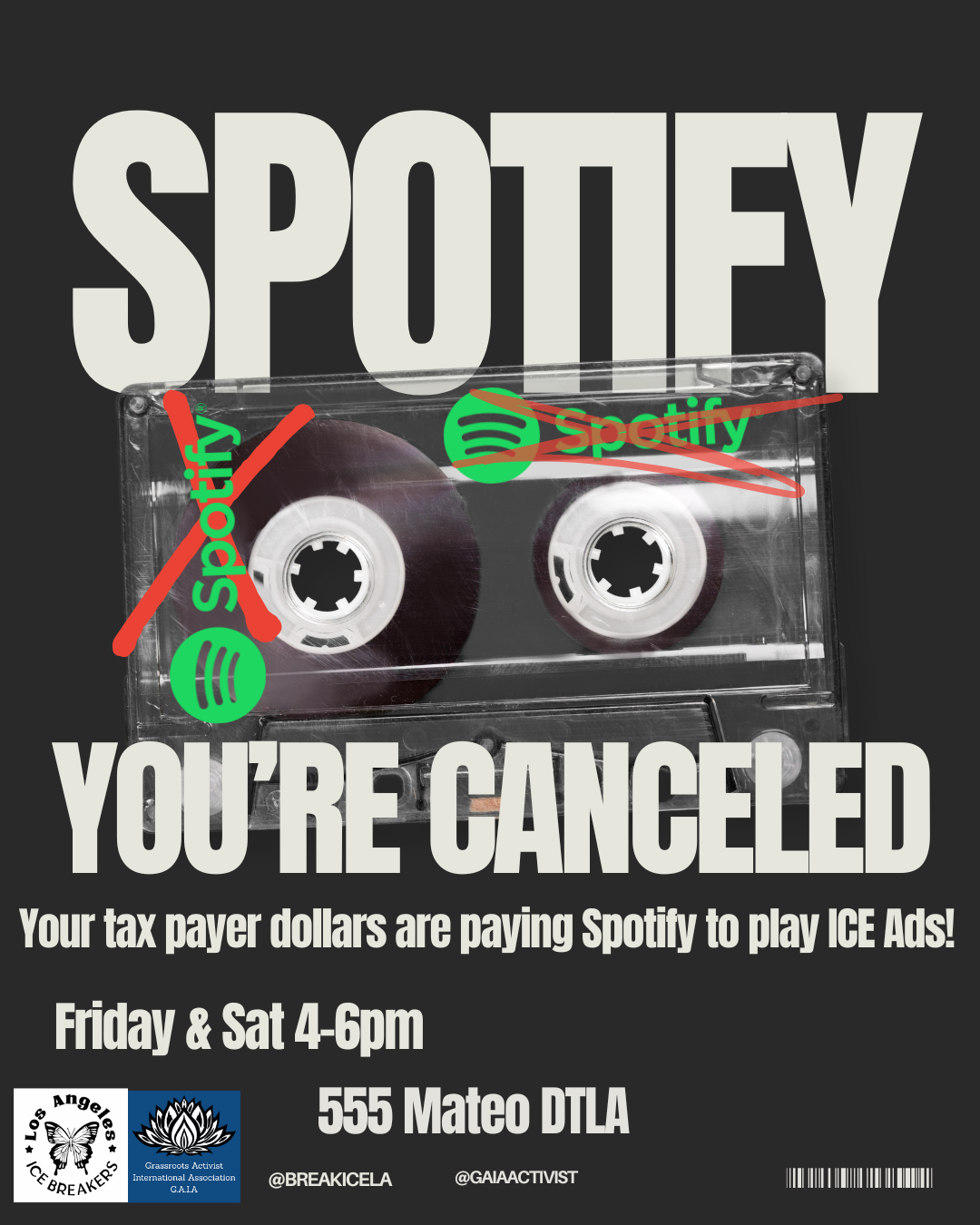
At GAIA, we started investigating this system through one company: Spotify.
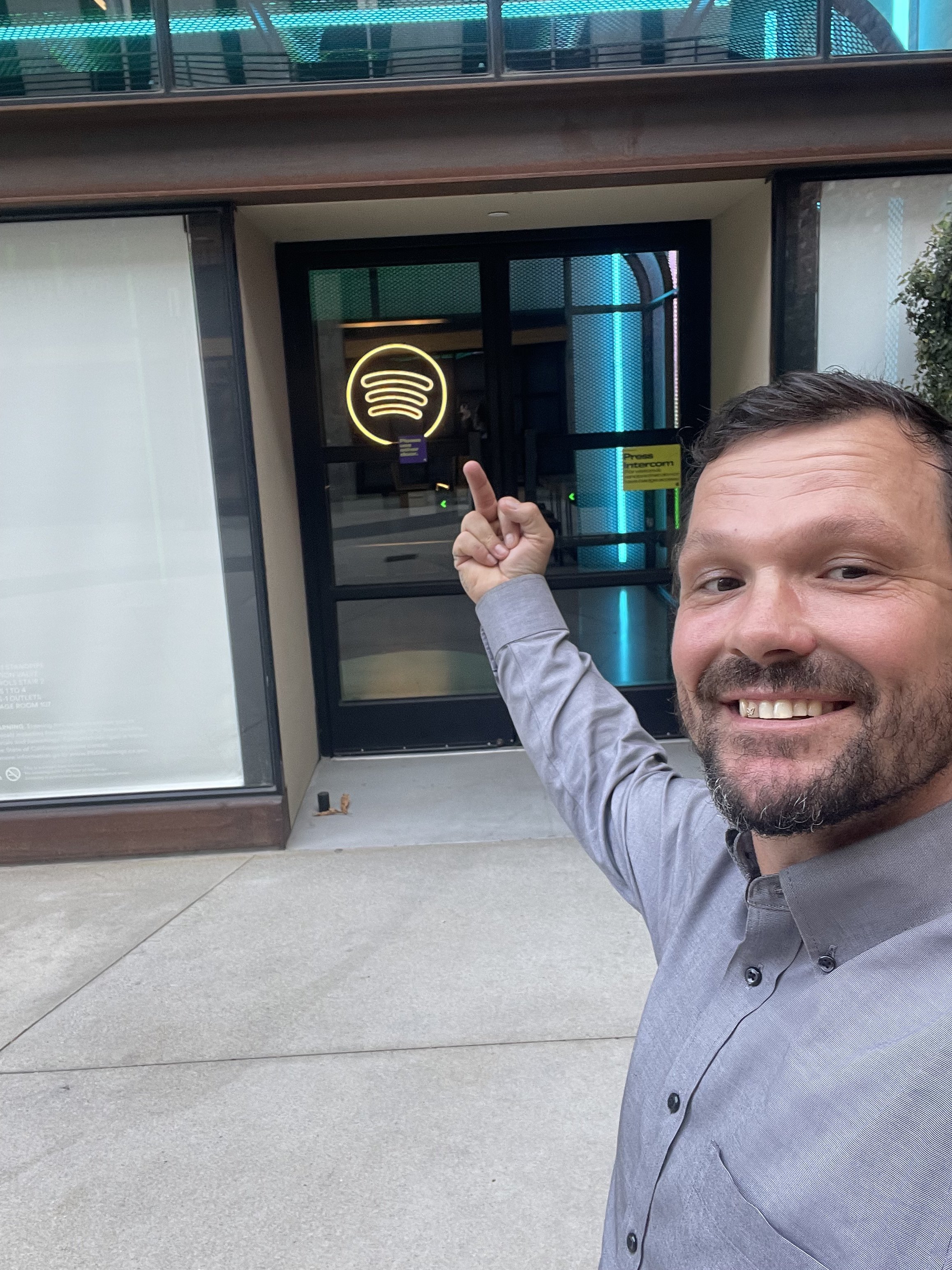
Our ICE Breakers campaign organized sustained protests outside Spotify's corporate offices, holding demonstrations twice a week for 11 weeks. We brought the issue directly to the company, challenged its relationship with ICE recruitment advertising, and built public pressure around a demand: stop running ICE recruitment advertisements.
Spotify later confirmed that ICE advertisements were no longer running on its platform. The company said the advertisements had ended as part of the government's broader recruitment campaign. We cannot independently establish that our protests caused the advertisements to end, but our campaign made Spotify's relationship with ICE a public issue and demonstrated how communities can organize around corporate accountability.
And that was only the beginning.
The question now is not simply which companies are running ICE advertisements. It's who is getting paid to create them, who is placing them, who is distributing them, and how public money is moving through the entire network.
We are calling this investigation UNPLUG THE MACHINE.
THE MACHINE IS BIGGER THAN WE THOUGHT
In 2025, the Washington Post reported on an internal ICE recruitment strategy that proposed a $100 million, one-year campaign. The plan described an extensive effort to recruit new personnel through targeted advertising, events, influencers, and a variety of media channels.
That figure requires an important distinction: the $100 million was a proposed campaign budget, not a verified accounting of money ultimately spent. Reporting also described contracts and awards connected to the broader effort, but the available public information does not establish that the entire proposed campaign was implemented.
Still, the proposal gives us a picture of the scale and sophistication of the operation being considered.
This was not simply about putting a few recruitment posters on a wall. The strategy described reaching potential recruits through digital advertising, streaming services, social media, connected television, gaming environments, billboards, and targeted outreach.
The government was looking beyond traditional advertising.
It was looking at the media ecosystem itself.

And that ecosystem is largely operated by private companies.
FOLLOW THE MONEY: THE CONTRACTORS BEHIND THE MESSAGE
The public record identifies several companies connected to this advertising and recruitment effort. Their contracts are not all the same, and it is important to distinguish the work each company was awarded.
Safe America Media
In February 2025, Safe America Media received a $143 million Department of Homeland Security advertising award connected to a broader $220 million advertising campaign.
The award has attracted scrutiny because of questions about the company's formation, the procurement process, and how the money was distributed.
Investigative reporting by ProPublica and questions raised by U.S. senators have highlighted the limited public clarity surrounding the distribution of the award and the involvement of subcontractors.
The $143 million award should not be confused with proof that $143 million was ultimately paid out to subcontractors. The full distribution of the money is a matter that warrants further investigation.
Safe America Media also received a separate $15 million ICE recruitment media-placement award in August 2025.
These are two distinct awards, and we intend to follow both.

People Who Think LLC
People Who Think LLC received a separate $24,974,000 award in August 2025 for ICE recruitment media-content creation.
This is a different contract from Safe America Media's media-placement award.
The distinction matters: creating advertisements and purchasing the media space where those advertisements appear are different parts of the advertising pipeline. Understanding who is responsible for each stage helps us understand how the system operates.
The Strategy Group
The Strategy Group reported receiving $226,137.17 from Safe America Media for production work.
According to the company's own statement, that work included:
Five film shoots.
Forty-five produced video advertisements.
Six produced radio advertisements.
That's a concrete example of how a large government advertising award can involve additional production companies and vendors.
Who else is receiving contracts? Which production companies are involved? Who is buying the advertising space? What other firms are being paid to reach audiences on behalf of federal agencies?
We want the full picture.
YOUR PHONE IS PART OF THE ADVERTISING NETWORK
The advertisements are not confined to television commercials or recruitment booths.
Reporting has documented ICE recruitment and immigration-enforcement-related advertising across a range of digital platforms and media outlets, including YouTube, Hulu, Max, Spotify, and Pandora.
It is important to distinguish between different kinds of government messaging. Some advertisements were intended to recruit ICE personnel. Others promoted self-deportation messaging or broader DHS communications. These campaigns should not be treated as one single advertising buy.
For example, reporting identified millions of dollars in federal advertising payments connected to Google/YouTube and Meta for self-deportation messaging. Those figures should not be presented as payments specifically for ICE recruitment advertisements.
The platforms themselves also have different relationships to the advertising system.
Pandora, for example, is part of SiriusXM, whose advertising business offers targeted advertising products across its media properties. That makes the company relevant to understanding the commercial infrastructure of digital audio advertising. However, we have not found reliable evidence establishing that Pandora received the largest share of ICE's audio advertising budget.
We are not interested in making claims that the records cannot support.
We are interested in finding the records that can answer the questions.
Who purchased the advertisements? Which agency authorized the spending? Which advertising networks received payment? Which platforms distributed the content? What audience data and targeting methods were used?
The more we understand the relationships, the more precisely we can investigate them.
TARGETING THE AUDIENCE: HOW DIGITAL ADVERTISING WORKS
One of the most important parts of this investigation is understanding how government advertising reaches particular audiences.
Digital advertising can be targeted using a variety of factors, including geography, age ranges, interests, content preferences, and other audience characteristics.
The Washington Post's reporting on ICE's recruitment strategy described plans for targeted outreach through multiple platforms and media channels. Separate reporting on DHS advertising also documented campaigns targeting particular audience interests, including Spanish-language and cultural interests.
These are significant questions for public accountability.
What audience categories were selected? Which advertising platforms were used? What data informed those decisions? Were particular communities disproportionately exposed to certain messages?
We also want to understand the difference between geographic targeting, behavioral targeting, interest-based targeting, and geofencing.
These terms are not interchangeable.
Geographic targeting can direct advertisements toward people in a particular area. Behavioral and interest-based targeting can use information about audiences' activities or preferences. Geofencing can use a defined geographic boundary to target devices in or around a location, subject to the technology and data involved.
We should not assume that every geographically targeted campaign used geofencing. Instead, we want to examine contracts, campaign documents, vendor materials, and public records to determine which techniques were actually used.
The public deserves to know how government agencies are using commercial advertising technology to communicate with and recruit people.
SPOTIFY: THE FIRST CAMPAIGN
Spotify was our entry point into this investigation.
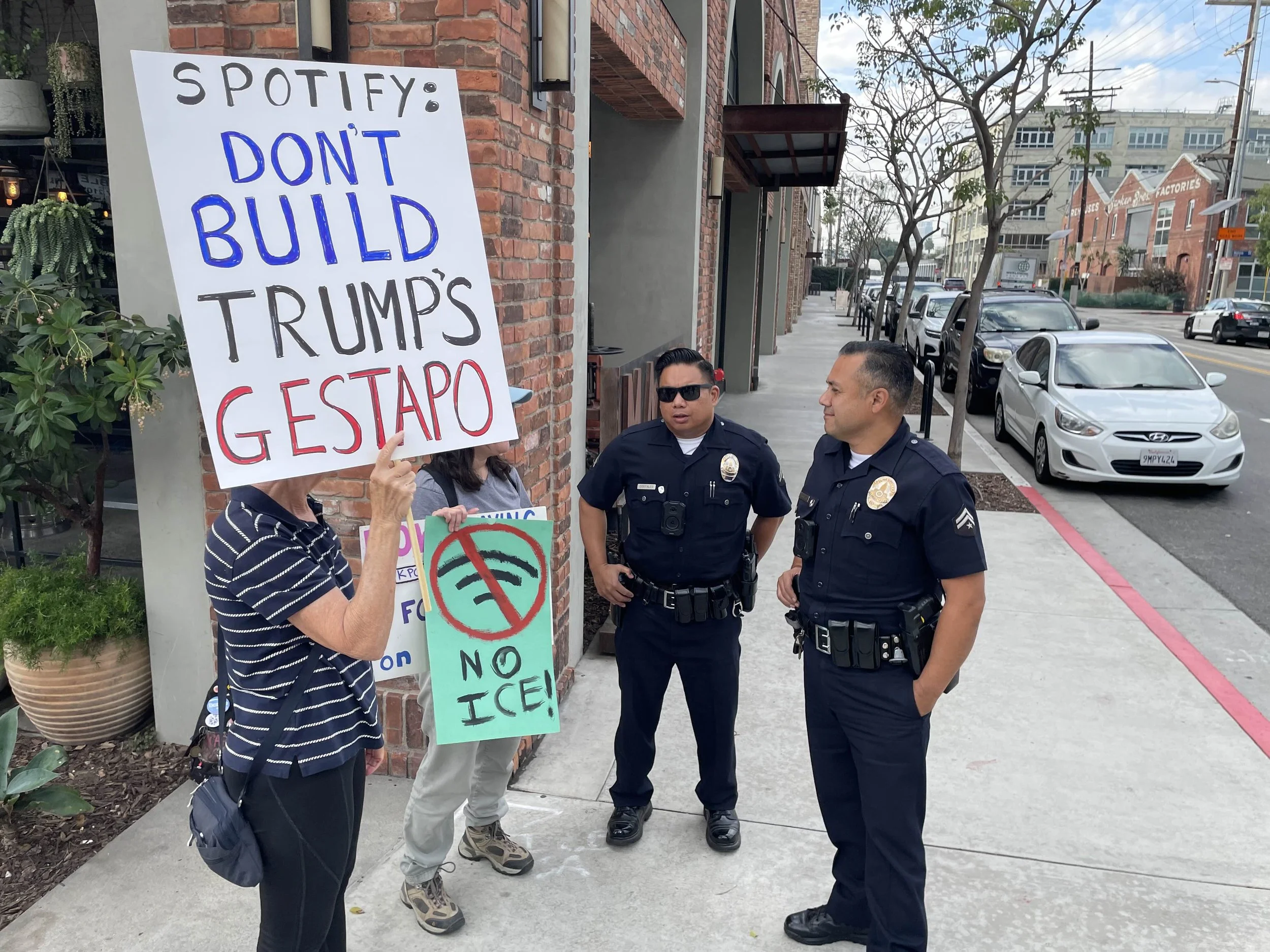
We didn’t back down!
ICE Breakers organized 11 weeks of protests outside Spotify's corporate offices, demonstrating twice a week and demanding that the company stop running ICE recruitment advertisements.
We did not receive corporate funding. We did not take money from wealthy private interests. We built our campaign through grassroots organizing, public support, direct action, and sustained pressure.
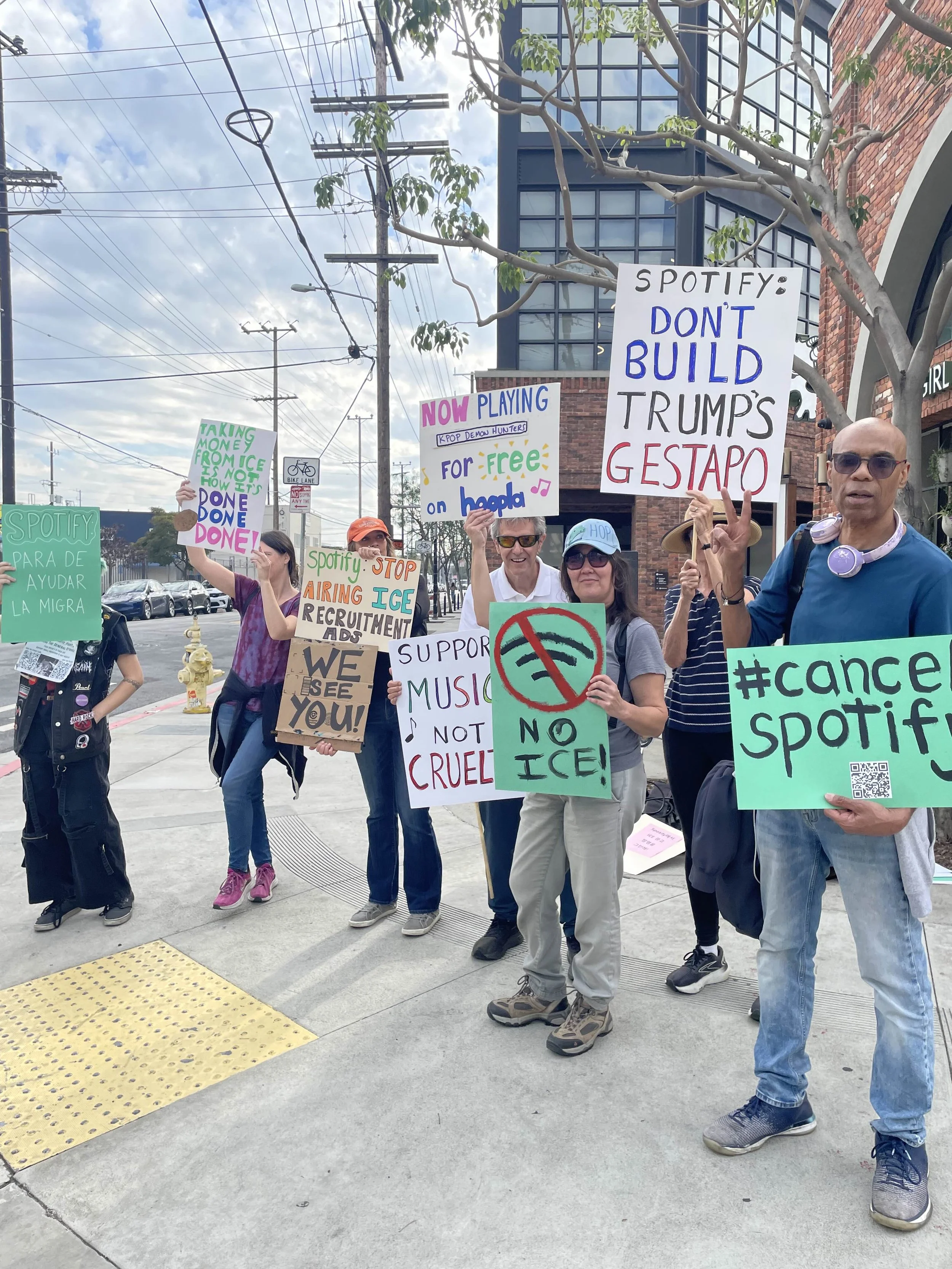
In January 2026, Spotify confirmed that ICE advertisements were no longer running on its platform.
The company said the advertisements had ended in late 2025 as part of the government's broader recruitment campaign.
Reporting placed the federal payment to Spotify for ICE advertisements at approximately $74,000.
That number is worth examining, but the amount of money involved is not the only issue. The larger question is how federal recruitment campaigns use commercial media platforms to reach the public.
Spotify was one company in a much larger network.
We began with one company. Now we are following the contracts, the advertising firms, the media buyers, the production vendors, and the platforms.
One campaign can open the door to an entire investigation.
FOLLOW THE MONEY. EXPOSE THE NETWORK.
This is where UNPLUG THE MACHINE begins.
We want to build a public, continuously updated map of the companies and relationships involved in federal immigration-enforcement advertising and recruitment.
That means investigating:
Federal contracts and procurement records.
Advertising agencies and media-placement firms.
Production companies creating recruitment content.
Streaming services and digital media platforms.
Social media advertising networks.
Audience-targeting and data services.
Subcontractors and vendors receiving federal advertising money.
The public officials and agencies authorizing these campaigns.
We also want to distinguish between confirmed payments, awarded contract amounts, proposed budgets, and reported plans. Those are different things. Following the money means being precise about where the money came from, where it was supposed to go, and what the available records actually establish.
We will publish our findings, link the underlying records wherever possible, and continue updating the investigation as more information becomes available.
If a company is receiving public money to create, place, or distribute these advertisements, the public has a legitimate interest in understanding that relationship.
THIS IS A COMMUNITY INVESTIGATION
We don't believe research should be locked away in an office or left exclusively to professional investigators.
We believe people should be able to participate in the process of understanding the systems that affect their communities.
That's why UNPLUG THE MACHINE will become part of our public organizing work.
Through Resistance News, we'll publish investigations and make the source material accessible. Through social media, we'll share findings and invite people into the conversation. Through GAIA's public townhalls, we'll bring people together to examine the network, develop research questions, identify companies, and discuss possible public accountability campaigns.
Our townhalls are not simply meetings where decisions are announced. They are spaces where members, community participants, and organizers can help shape the work.
We want researchers, artists, media workers, organizers, students, and anyone interested in public accountability to participate.
Bring documents. Bring questions. Bring your research. Help us connect the dots.
UNPLUG THE MACHINE
The advertising network is one part of a much larger system.
Federal agencies rely on private companies to produce messages, purchase media, distribute advertisements, and reach audiences. Those relationships deserve scrutiny, especially when public money is being used to promote recruitment and immigration-enforcement campaigns.
We started with Spotify because it was a company we could organize around. We built public pressure, sustained a campaign, and opened the door to a much bigger investigation.
Now we're working our way up the chain.
We want to understand the entire infrastructure. We want to expose the financial relationships. We want to challenge the companies that choose to participate in these campaigns. And we want to build the public pressure necessary to demand accountability.
We will leverage each investigation and each campaign to inform the next. We will connect the dots, share what we find, and organize with the communities affected by these systems.
We don't need wealthy interests or corporate sponsors to do this. We need people willing to investigate, organize, and act together.
This is grassroots research. This is public accountability. This is creative resistance.
UNPLUG THE MACHINE.
Follow Resistance News. Join a GAIA public townhall. Help us investigate the network.
ABOUT THIS INVESTIGATION
Resistance News is a grassroots investigative publication of the Grassroots Activist International Association (GAIA).
Our reporting examines the financial relationships, institutional structures, and corporate partnerships that affect our communities. We use public records, government contracts, investigative reporting, and firsthand documentation to inform our work.
We distinguish verified facts from allegations, reported claims, proposed plans, and ongoing investigative questions. We welcome documented corrections and responses from the individuals, companies, and institutions discussed in our reporting.
Research is part of resistance. Public accountability is part of organizing.